
Want to join an MBA in 2025? This guide covers everything you need — MBA admission criteria, step-by-step process, course details, fees, and full syllabus. Find out what marks you need, which entrance exams to give like CAT and GMAT, and what documents to keep ready. We explain every step in simple words so you never feel lost. Whether you are a fresher or have work experience, this guide helps you apply with full confidence. Start your MBA journey today!

Table of Contents
MBA Admission Process: Complete Guide for Students
Many students dream of studying in a good business school and building a successful career in management. However, before starting their MBA journey, they need to understand the MBA admission process. Knowing the right steps can help students prepare better and avoid common mistakes.
The MBA admission process includes checking eligibility, preparing for entrance exams, submitting applications, attending interviews, and securing admission. While different colleges may have different rules, most institutions follow a similar process.
This guide explains the complete MBA admission process in simple language. Whether you are a fresher or a working professional, this article will help you understand every important step.
MBA admission criteria often include entrance exam scores as a key requirement.
The MBA admission process is the method colleges and business schools use to select students based on their MBA admission criteria.
During this process, colleges evaluate a student’s academic background, entrance exam score, skills, and overall profile. The goal is to choose candidates who are ready for management studies and future leadership roles.
The MBA admission process usually includes:
- Checking eligibility
- Choosing MBA colleges
- Taking an MBA entrance exam
- Preparing documents
- Submitting applications
- Attending interviews
- Receiving admission offers
Understanding these steps can make the admission journey much easier.
MBA Admission Criteria:
Before starting the MBA admission process, students should understand the basic MBA admission criteria.
Educational Qualification
Most colleges require candidates to have a bachelor’s degree from a recognized university.
Students from different backgrounds can apply, including:
- B.Com
- BBA
- B.Tech
- BA
- B.Sc
Most colleges ask for at least 50% marks in graduation.
Entrance Exam Scores
Many colleges consider entrance exam scores during the selection process.
Popular exams include:
- CAT
- XAT
- SNAP
- NMAT
- MAT
- CMAT
- GMAT
A good score can improve your chances of getting admission to a top business school.
Work Experience
Work experience is not compulsory for every MBA program.
Many colleges accept fresh graduates. However, Executive MBA programs usually prefer candidates with work experience.
Personal Interview
Many institutes conduct interviews to understand a candidate’s goals, communication skills, and interest in management studies.
Step-by-Step MBA Admission Process
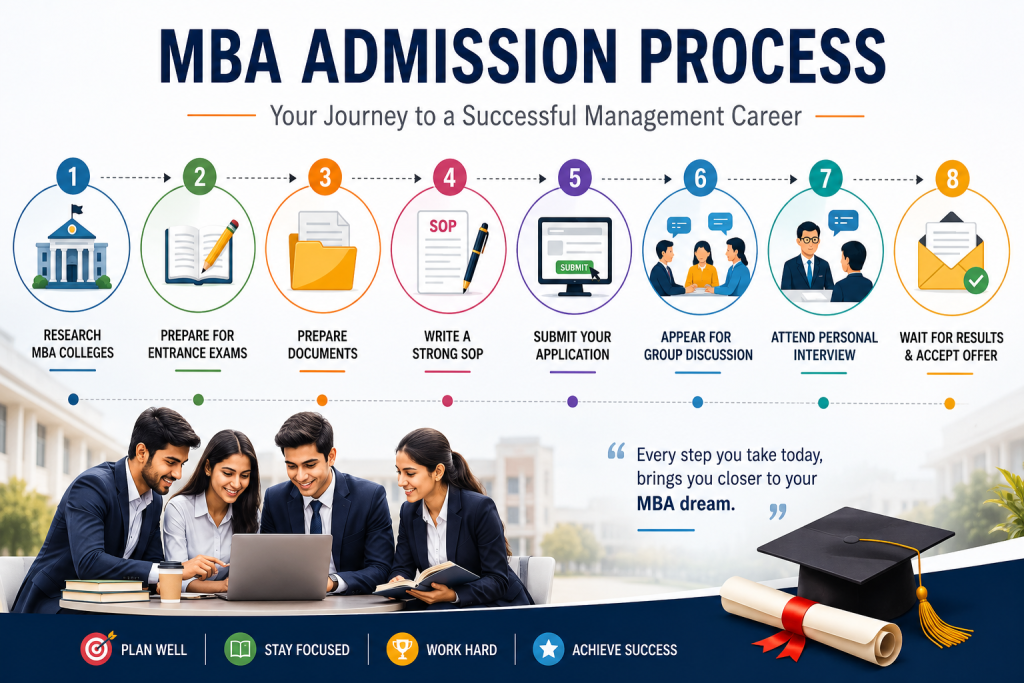
Step 1: Research MBA Colleges
The first step in the MBA admission process is selecting the right colleges.
Students should compare:
- Courses offered
- Placement records
- Fees
- Location
- Specializations
Preparing a list of suitable colleges helps students stay focused during the application stage.
Step 2: Prepare for Entrance Exams
Entrance exams are an important part of the MBA admission criteria.
Students should start preparing early and create a study plan. Regular practice, mock tests, and time management can improve exam performance.
The most popular exam in India is CAT, while many international programs accept GMAT scores.
Step 3: Prepare Application Documents
The next stage of the MBA admission process involves preparing important documents.
Commonly required documents include:
- Graduation certificates
- Academic transcripts
- Entrance exam scorecards
- Resume or CV
- Passport-size photographs
- Identity proof
Keeping documents ready before deadlines can save time and reduce stress.
Step 4: Write a Strong SOP
Many colleges ask students to submit a Statement of Purpose (SOP).
An SOP explains:
- Why you want to pursue an MBA
- Your career goals
- Your achievements
- Why you chose a particular college
A clear and honest SOP can strengthen your application.
Step 5: Submit Your Application
Once your documents and SOP are ready, the next step is to submit your application.
Most colleges now accept online applications. You need to fill in a form with your personal details, academic records, and work experience (if any).
Always check the application deadline of each college. Missing a deadline means missing a chance. So keep a calendar and mark all important dates.
Some colleges charge a small application fee. Keep your payment method ready before you start filling the form.
Step 6: Appear for Group Discussion (GD)
Many top business schools conduct a Group Discussion round before the final interview as part of their MBA admission criteria.
In GD, a group of students discuss a topic together. The panel checks how well you speak, listen, and share ideas.
Here are some simple tips to do well in GD:
- Speak clearly and to the point
- Listen to others before you respond
- Do not interrupt anyone
- Use simple words and real examples
- Stay calm even if you disagree with someone
GD is not about who talks the most. It is about who talks the best.Step 7: Attend the Personal Interview (PI)
Personal Interview is one of the most important parts of the MBA admission criteria. It is your chance to show who you are beyond your marks and scores.
The interview panel may ask questions like:
- Tell me about yourself
- Why do you want to do an MBA?
- Where do you see yourself in 5 years?
- What are your strengths and weaknesses?
- Why did you choose this college?
Be honest in your answers. Do not memorize scripts. Speak from your heart and stay confident.
Dress neatly. Reach on time. Smile and stay polite throughout the interview.
Step 8: Wait for the Results and Accept the Offer
After completing all rounds, the college will announce results.
If you get selected, you will receive an admission offer letter. Read the letter carefully. Check the fee details, joining date, and other terms.
Pay your admission fee on time to confirm your seat. Some colleges also have a waiting list. If you are on it, do not lose hope. Keep checking for updates.
MBA Fees: How Much Does It Cost?
MBA fees can vary a lot depending on the college and the program type.
Here is a general idea of MBA fees in India:
| College Type | Approximate Fees |
|---|---|
| Government Colleges | Rs. 20,000 – Rs. 1,00,000 per year |
| Private Colleges | Rs. 2,00,000 – Rs. 10,00,000 per year |
| Top IIMs & Premium Institutes | Rs. 15,00,000 – Rs. 25,00,000 (Full Program) |
Students can also apply for education loans, scholarships, and financial aid to manage the fees. Many banks offer MBA education loans at low interest rates.
Always check the fee structure on the official college website before applying.
MBA Syllabus: What Will You Study?
The MBA syllabus covers a wide range of business topics. The course is usually divided into four semesters over two years.
| First Year MBA Subjects (The first year covers basic management subjects. These give you a strong foundation in business.) | Second Year MBA Subjects (After meeting the MBA admission criteria, students can choose a specialization based on their career goals and interests.) |
|---|---|
| Principles of Management | Marketing |
| Financial Accounting | Finance |
| Business Communication | Human Resource Management (HRM) |
| Economics for Managers | Operations |
| Marketing Management | Information Technology (IT) |
| Human Resource Management | International Business |
| Operations Management | Supply Chain Management |
| Business Law | Entrepreneurship |
| Quantitative Methods | Projects & Internships |
| Organisational Behaviour | Case Studies |
Each specialization has its own set of subjects. You also do projects, internships, and case studies in the second year.
Types of MBA Programs Available
There is not just one type of MBA. Students can choose a program that fits their life and career plans.
Full-Time MBA
This is a regular 2-year course. Students attend college every day. It is best for freshers and those who can study without working.
Part-Time MBA
Part-time MBA lets you study while working. Classes are held in the evenings or on weekends. It is a great option for working professionals.
Executive MBA (EMBA)
EMBA is designed for people with several years of work experience. The MBA admission criteria for EMBA usually requires at least 5 years of work experience.
It focuses more on leadership, strategy, and decision-making.
Online MBA
Online MBA programs are growing in popularity. You study from home using the internet. It is flexible and often less expensive.
Many top universities in India and abroad now offer online MBA programs. Check if the college has AICTE or UGC approval before enrolling.
Distance MBA
Distance MBA is similar to online MBA. You get study material sent to you and appear for exams at exam centres.
IGNOU and many state universities offer distance MBA programs at very affordable fees.
Tips to Meet MBA Admission Criteria and Get Selected
Meeting the MBA admission criteria is only the first step. Here are some practical tips to improve your chances of getting selected:
1. Start exam preparation early
CAT and other MBA entrance exams are an important part of the MBA admission criteria. Start preparing at least 6 months before the exam. Join a coaching class or use free online resources.
2. Focus on your weak areas
Most MBA exams have three sections: Verbal Ability, Quantitative Aptitude, and Data Interpretation. Find out which area you struggle with and give it more time.
3. Work on your communication skills
MBA interviews and GD rounds are important stages of the MBA admission criteria. Practice speaking in English every day. Talk to friends, watch English news, and read newspapers.
4. Build a good resume
Even if you are a fresher, you can list your internships, projects, certificates, and activities. A clean and well-organized resume makes a good first impression.
5. Apply to multiple colleges
Do not apply to just one college. Apply to 5 to 10 colleges with different levels of difficulty. This gives you more options.
6. Write a genuine SOP
Many students copy SOPs from the internet. Instead, write your own story. Talk about your real experiences and actual goals. A genuine SOP can help you meet the MBA admission criteria more effectively.
7. Prepare for common interview questions
Practice answering common MBA interview questions with a friend or in front of a mirror. Good preparation can help you clear the MBA admission criteria with confidence.
Common Mistakes to Avoid During MBA Admission
Many students make simple mistakes that cost them a good seat. Here are the most common ones and how to avoid them:
Mistake 1: Missing Application Deadlines
Following MBA admission criteria also means keeping track of application deadlines. Colleges have strict deadlines. If you miss it, you cannot apply that year. Make a list of all deadlines and set reminders on your phone.
Mistake 2: Not Researching the College
Some students apply to colleges without checking their ranking, placement record, or fee structure. Always check the MBA admission criteria before you apply.
Mistake 3: Poor SOP Writing
A bad SOP can hurt your application even if your scores are good. Spend time writing a clear and personal SOP. Ask a teacher or mentor to review it.
Mistake 4: Ignoring Soft Skills
MBA programs need students who can communicate and lead. Do not focus only on exam scores. Work on your personality, teamwork, and communication from the beginning.
Mistake 5: Applying Without Checking Eligibility
Read the MBA admission criteria of each college carefully. Some colleges need specific marks or work experience. Applying without checking is a waste of time and money.
Frequently Asked Questions (FAQs)
Q1. What is the minimum percentage needed for MBA admission?
Most colleges ask for at least 50% marks in graduation. Some premier institutes may ask for 60% or more. SC/ST candidates usually get a relaxation of 5%.
Q2. Is work experience needed for MBA admission?
For regular MBA programs, work experience is not required. Fresh graduates can apply. However, for Executive MBA, you usually need 5 or more years of work experience.
Q3. Which entrance exam is best for MBA admission?
CAT is the most popular MBA entrance exam in India. It is accepted by IIMs and hundreds of other top colleges. GMAT is used for international programs. XAT, SNAP, NMAT, and MAT are other popular options.
Q4. Can I do MBA without appearing in CAT?
Yes. Many colleges accept other entrance exam scores like XAT, MAT, CMAT, SNAP, or NMAT. Some colleges also conduct their own entrance tests.
Q5. Are there any scholarships for MBA students?
Yes, many scholarships are available for MBA students. Government schemes, college merit scholarships, and private foundation scholarships are some options. You can also apply for an education loan from banks like SBI, HDFC, or Axis Bank.
Conclusion
The MBA admission process may seem complicated at first, but it becomes easy when you break it into small steps.
Start by understanding the MBA admission criteria that colleges look for. Then prepare well for every stage of the MBA admission criteria, including entrance exams, documents, SOP writing, and interviews.
Remember, every student has a different journey. Do not compare yourself with others. Focus on your own preparation and give your best.
If you stay consistent and plan well, you will find the right MBA college for you. Good luck with your MBA journey!